The Complete Guide to Driving on the Las Vegas Strip: Parking, Rideshare Pickup Zones, and Streets to Avoid

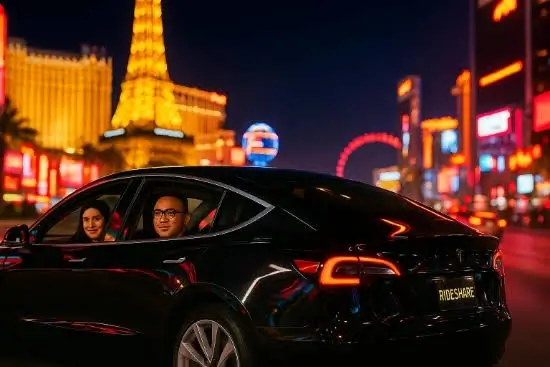
Four and a half miles of Las Vegas Boulevard hold more hotel rooms, more foot traffic, and more people making a left turn from the wrong lane than almost any comparable stretch of road in the country. It is a spectacular place to visit and a genuinely confusing place to drive.
The good news is that Strip traffic is not Los Angeles traffic. It is not even close. The bad news is that it does not behave like normal city traffic either, because the thing slowing you down is rarely volume. It is the garage you cannot find, the pickup zone that turns out to be on the second floor, the pedestrian stepping off a median in the dark, and the show that just let out at the property you are trying to drive past.
We are Las Vegas car accident lawyers, and we have sat in that traffic clutching the steering wheel like everyone else. We have also seen what happens on this road when someone gets impatient. So here is the practical version: what parking actually costs, where your rideshare driver is really going to meet you, and which streets to stay off entirely.
Parking on the Strip: what you will actually pay
Free parking on the Strip mostly ended in 2016, and the resorts have been adjusting rates ever since. Most major properties now charge for self-parking by the day, usually somewhere between $20 and $25, with the higher number landing on weekends. Valet runs around $40.
One important caveat: these rates change with events, with your loyalty tier, and whenever a property revisits its policy, which happens more often than you would think. Wynn alone has gone back and forth on non-guest parking more than once. Check the posted signage or the property’s site the day you go.
Where parking is still genuinely free
Three Strip properties still let anyone self-park at no charge: Circus Circus, Treasure Island, and Sahara Las Vegas. That is the honest list. If someone tells you the Palazzo is free, they are working from an old article. The Venetian and Palazzo have charged for self-parking since 2023.
Circus Circus is the northern anchor of that trio, Treasure Island sits center Strip across from the Venetian, and Sahara is at the north end near the Strat. Between them you can park free and walk or take the Monorail to a surprising amount of the Boulevard, as long as you are willing to trade a few minutes for the savings. Event nights can change the math at Circus Circus, so look at the sign before you pull in.
The Nevada resident rule, stated correctly
If you live here, you probably already know this one, but it gets repeated wrong constantly. Most major operators, including MGM Resorts, Caesars Entertainment, and the Venetian, give Nevada residents three complimentary hours of self-parking. Resorts World goes further and treats residents as complimentary rather than capping it at three hours.
Two things people get wrong. First, it is your driver’s license, not your license plate. You scan it at the kiosk on the way out. A Nevada plate on a rental will not do anything for you. Second, the benefit usually disappears when event pricing is in effect, which is exactly when you were counting on it. Big fight nights, race weekends, and major residencies all qualify.
Self-park or valet
This is a straight trade between time and money. Valet costs roughly twice what self-parking does and drops you at the door. Self-parking saves you $20 and costs you the walk from the fifth level of a garage, through the casino floor, to wherever you were actually going. On a Saturday night at a big property, that walk is not five minutes.
If you are meeting people at a specific time, or you are in heels, or it is 110 degrees, valet is the better buy. Otherwise self-park.
Parking downtown and at Fremont Street
Downtown plays by different rules than the Strip, and it is worth treating as a separate trip.
City street meters downtown and through the Arts District run roughly $2 to $4 an hour after last October’s increase. The detail almost nobody mentions: the city offers free street parking on weekdays from 11 a.m. to 2 p.m., which makes a downtown lunch meaningfully cheaper than a downtown dinner.
For Fremont Street itself, the Fremont Street Experience garage at 111 S. 4th Street is the straightforward option. It is open around the clock with more than 1,300 spaces, and the first 15 minutes are free. Pricing is banded rather than flat: Monday through Thursday between 3 a.m. and 5 p.m. there is an early bird rate of $4 an hour with a $20 daily cap, and outside that window it runs $5 for the first half hour, $8 for an hour, $15 for two, $18 for three, and $25 for anything from three to twenty four hours. The entrance is off 4th Street between Carson and Fremont, and 4th is one way, so you need to come at it from Carson.
The casino garages downtown vary widely. Golden Nugget and Plaza are free for hotel guests and charge everyone else, with Golden Nugget jumping sharply on weekends. Binion’s and Four Queens charge by the hour with a daily cap. If you are staying downtown, park where you sleep.
Apps help here more than they do on the Strip. SpotAngels maps free and metered spots along with street rules, and Flowbird and ParkMobile let you pay and extend from your phone. Policies and coverage change, so confirm rates in the app before you rely on them.
Where rideshare actually picks you up
This is the part that catches visitors off guard. You cannot simply stand on the sidewalk on Las Vegas Boulevard and wait for your Uber. The resorts route rideshare into designated zones, and those zones are frequently nowhere near the front door. Your driver cannot legally stop for you at the curb out front, which is why they keep circling, canceling, or calling you while you stand there watching your fare climb.
The fix is knowing where the zone is before you request the ride, and dropping your pin there instead of on the Boulevard.
MGM Grand: First floor of the self-parking garage, reached through The Underground hallway off the lobby
Bellagio: South tower lobby, near the main entrance and hotel registration
ARIA: North valet lobby, past the lounge and patisserie, then down toward the nightclub level
Cosmopolitan: Back of the property, past hotel registration, in the parking ramp
The Venetian: Second level of the parking garage, along the far back wall
Caesars Palace: Toward the back of the resort past the food hall, then left. This one has moved during construction, so check the app
Wynn and Encore: Any resort entrance, one of the few properties without a single dedicated zone
Mandalay Bay: Parking ramp, off the casino floor past the bar and the mini golf
Luxor: North entrance closest to the towers, at the start of the Excalibur walkway. Not the main porte cochere
Paris: Outside the north entrance, near the sports book
Planet Hollywood: Near the main vehicle entrance, just outside the hotel lobby
Flamingo: South entrance on the lower level, down the escalators to the left of registration
Treasure Island: Right from the main porte cochere, following the sidewalk to a marked zone across the street
Resorts World: Outside the self-parking ramp, though requesting pickup at the Hilton or Conrad hotel entrances is usually easier
LINQ: Rear of the resort, past the retail corridor. One of the longer walks on the Strip
Harry Reid Airport, Terminal 1: Level 2 of the parking garage. Elevator near Door 2, across the pedestrian bridge, pickup is to your right
Harry Reid Airport, Terminal 3: Valet Level of the parking garage. Elevators near Doors 52, 54, or 56 up to Level 1, across the bridge, then down
Easy to follow rule at Harry Reid International Airport: pick up your rideshare in the garage, not at the curb outside the terminal. To get to Level 2 in Terminal 1, take the elevator near Door 2. Then, cross the pedestrian bridge into the garage and look to your right to find the pickup area. Lifts near Doors 52, 54, or 56 in Terminal 3 can take you to Level 1. From there, cross the bridge and go down to the Valet Level.
Build in ten minutes for that walk. People miss it constantly, and then stand at baggage claim wondering why the driver is asking them to come outside.
Streets to avoid, and the ones locals use instead
The single most useful habit you can build here is treating Las Vegas Boulevard as a destination rather than a route. If you are trying to get from one end of the Strip to the other, the Boulevard is almost always the slowest way to do it.
Where it snarls
Las Vegas Boulevard itself, any evening, but especially in the twenty minutes after the big shows let out. The Tropicana and Flamingo intersections, where four corners of resort traffic meet and the pedestrian bridges dump crowds into the crosswalk cycles. Anything near Sphere on an event night. Paradise Road during convention weeks, when the Convention Center empties all at once. And the whole corridor on race weekends and New Year’s Eve, when the Boulevard shuts down outright.
What to take instead
West side of the Strip:
- Frank Sinatra Drive runs between I-15 and the back of the resorts, roughly from Russell Road north to Dean Martin. It is the back door to Mandalay Bay, Luxor, New York-New York, Park MGM, Bellagio, and Caesars Palace.
- Dean Martin Drive is the longer parallel run, with the practical stretch going from about West Hacienda up to Sahara. If you are continuing toward downtown, jog over via Wyoming to Main Street. Longtime locals still call this Industrial Road, which is what it was named until 2005, so do not get confused when someone gives you directions using the old name.
East side of the Strip:
- Koval Lane runs roughly from Tropicana up to Sands and gives you back door access to everything from MGM Grand through the Venetian.
- Paradise Road picks up north of Sands and carries you toward Westgate, the Convention Center, Sahara Avenue, and The STRAT.
- Sammy Davis Jr. Drive handles the north end near the Convention Center and Westgate.
None of these are secrets, and they are not empty. They are just moving, which the Boulevard often is not.
Road closures and how to check before you go
Las Vegas reconfigures itself constantly. Overnight lane reductions, construction on the resort corridor, full Strip shutdowns for races and events, and the ordinary crash that closes two lanes for an hour. Downtown has had its own stretch of closures and construction that businesses there have been vocal about.
Rather than guessing, check before you leave. Nevada DOT runs the state’s 511 system at nvroads.com, with live conditions, closures, and traffic cameras. The RTC covers transit and local road work, and the resort you are heading to will post its own event calendar, which is usually the best predictor of when the Boulevard is going to lock up. Two minutes of checking saves you forty minutes of sitting.
A word about the pedestrian bridges
Those overpasses at Tropicana, Flamingo, and the other major intersections are not there for the view. They exist because crossing Las Vegas Boulevard at street level, on foot, in a crowd, at night, is one of the more dangerous things a person can do in this city.
As drivers, the practical takeaway is that you should expect people on foot where they should not be. Someone will step off a median. Someone will cross mid block because the bridge stairs looked like too much work. Slow down through those intersections and give yourself room, particularly after dark and particularly when the sidewalks are full. If you are the one on foot, use the bridge. It is worth the stairs. Nevada law gives pedestrians significant protections, but no legal protection undoes what happens at forty miles an hour.
Closing Argument
Driving the Strip well is mostly about lowering your expectations and raising your attention. Assume the garage will take longer than you planned. Assume your rideshare driver cannot reach the curb. Assume someone will cross where they should not, and assume the driver next to you is looking at the Sphere instead of the road.
None of that is pessimism. It is just how this particular four and a half miles works. Plan around it and Las Vegas is a genuinely easy city to get around. Fight it and you will spend your evening in a left turn lane.
Drive defensively, be patient with the tourists, and if the worst does happen, know what your options are. We want everyone on this road to get where they are going.